
Cardiovascular disease
Coronary heart disease can remain silent until a heart attack or another complication. Reviewing risk factors matters even when someone feels well. [3]
Personalized wellness for the people behind the badge, the uniform and the emergency call—with agency support and individual health at the center.

Long shifts. Interrupted sleep. Repeated exposure to stress and trauma. Protecting those who serve means paying attention to the health risks that can build behind the uniform.
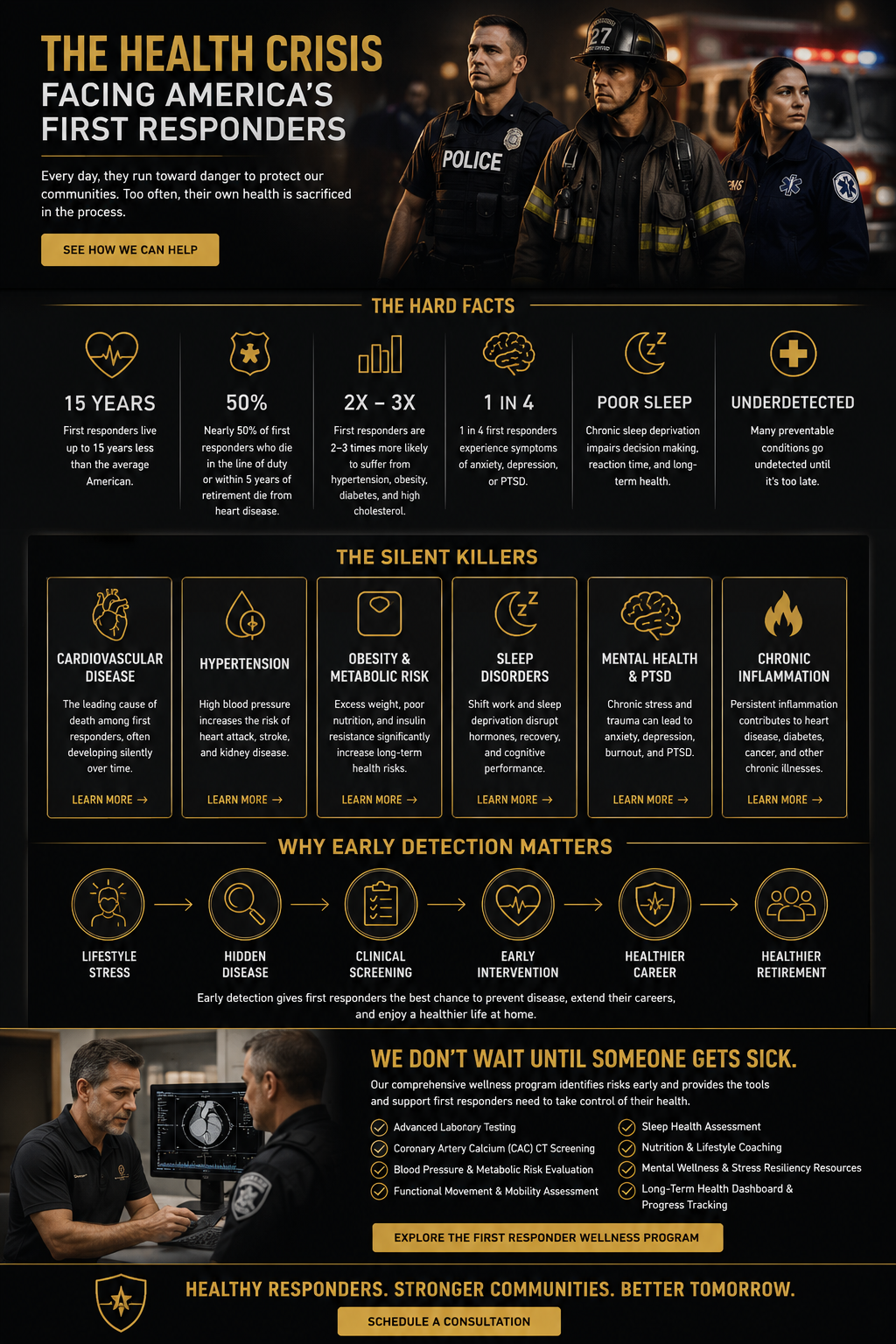
About the brochure’s statistics: The artwork is reproduced as supplied. Its headline figures should not be read as current estimates for all first responders. The lifespan figure comes from older law-enforcement literature; the 45–50% finding concerns on-duty firefighter deaths, not all responders or a five-year retirement window; and the 2–3× finding concerns adverse outcomes among firefighters with severe hypertension, not the prevalence of four diseases. See the lifespan context [10], firefighter mortality review [11] and hypertension study [12]. The brochure’s “1 in 4” mental-health figure is not established here as a general rate for all first responders.
Wellness starts before a crisis. Give your people a clear path from awareness to assessment and ongoing support.
Why detection mattersSome risks develop quietly. Others get dismissed as “part of the job.” Looking beneath the surface creates room for earlier support.
Coronary heart disease can remain silent until a heart attack or another complication. Reviewing risk factors matters even when someone feels well. [3]
High blood pressure usually has no warning symptoms. Unmanaged, it can damage the heart, brain and kidneys. Measuring it makes the risk visible. [4]
Excess weight, inactivity and insulin resistance can affect long-term health. Prediabetes often has no symptoms; appropriate testing and personalized lifestyle support help guide next steps. [5]
Shift demands can make poor sleep seem normal. Sleep apnea and other sleep disorders deserve evaluation; fatigue can affect alertness and on-duty safety. [6]
Trauma-related symptoms can affect sleep, concentration, relationships and work. Confidential support and appropriate treatment should be part of the conversation. [7]
Persistent inflammation can damage tissue. A marker such as CRP needs clinical interpretation: an elevated result alone does not identify its cause. [8]
Understand the demands of long shifts, disrupted sleep, nutrition, recovery and repeated stress.
Review health and family history alongside risk factors that may not cause obvious symptoms.
Choose blood-pressure checks, appropriate labs and further assessments with a licensed provider.
Turn findings into a personal plan for care, referrals, nutrition, movement and follow-through.
Support day-to-day well-being with ongoing coaching, progress reviews and appropriate reassessment.
Build habits and care relationships that continue beyond the job, with personal health and family life in focus.
Depending on clinical needs and program scope, the conversation may include:
Coronary artery calcium (CAC) scanning may help selected patients clarify cardiovascular risk; it is not a universal screening test. A clinician determines whether it is appropriate. [9]
Every first responder has a different health history, work schedule and set of goals. Their wellness support should reflect that.
The First Responders Wellness Program combines individual health assessment, personalized coaching and ongoing support, helping agencies make wellness a continuing priority.
Lab findings, biometric information, cardiovascular risk, lifestyle and personal goals inform the next steps with a licensed provider.
Personalized nutrition, movement and coaching support strength, mobility and daily habits around demanding schedules.
Make space for recovery, sleep and stress-management support, including referral pathways for needs outside the coaching program.
Keep the conversation going through accountability, follow-up and appropriate reassessment with the care team.
A clear department-level view of participation, health trends and program follow-through—to help leaders understand where support is needed.
participation, engagement and assessment completion.
Aggregate cardiovascular, metabolic, sleep and well-being trends.
Program activity, progress reviews and priorities for the next period.
The proposed command view uses aggregate reporting. Individual lab results, diagnoses and treatment belong in the clinical care relationship. Reporting rules, access and minimum group sizes should be agreed before launch to reduce identification risk.
Define participation goals, the review period and the measures that matter to your agency. Any financial analysis should use documented costs and clearly stated assumptions.
Book a Free Discovery CallDiscuss agency needs, shift patterns and goals.
Agree on the participant group, services and rollout.
Guide participants through assessment and individual planning.
Support follow-through and review aggregate program progress.
Study findings are presented with their population and publication date. Educational content reviewed October 10, 2026. The three headline callouts use narrower, source-supported wording than the supplied program graphic.
Start with Mix & Match, or choose one of our three complete packages. Your estimate updates as you go.
Mix & Match demo: build a sample basket using the current add-on prices. Standalone rates, any required membership or medical care, and setup fees are confirmed with our team. Employer and agency arrangements require a program-specific quote.
This program page is designed for agency and association conversations. Individual responders can also contact the team to discuss the options available to them.
No. The program is centered on each person’s assessment, lifestyle, health goals and appropriate clinical guidance.
The proposed leadership view focuses on aggregate participation, risk trends and engagement. It is separate from individual clinical records; reporting arrangements are established before participation.
No. Licensed medical professionals determine appropriate evaluations and treatment. Program participation does not guarantee a prescription.
Talk with our team about a wellness program for your agency or association.